
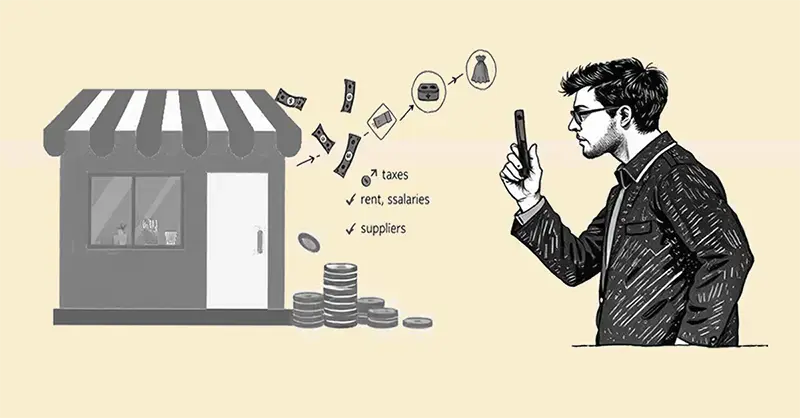
The Invisible Mechanics of Cash Flow
Most entrepreneurs believe cash-flow problems are caused by external factors: a bad market, missed opportunities, or insufficient funding. In reality, the problem lives internally — in invisible, untracked micro-decisions. These are the small choices every day that nobody records, questions, or teaches anyone to manage properly.
When I joined one of Moscow’s largest construction holdings — a $500M-a-year operation — I witnessed the same quarterly panic repeatedly. The CFO running between offices, the head of finance juggling spreadsheets, the chief accountant muttering, “Where is the money?” The company had cash, invoices, and payments moving like a river, yet financial chaos reigned. The culprit? Lack of a structured system that connects accounting with actionable cash-flow intelligence.
Small businesses rarely distinguish between bookkeeping and cash-flow management. Accounting shows what happened. Cash-flow systems predict what will happen. They force a business to answer three crucial questions every day:
1.Which funds are actually available? Most owners see the bank balance and assume it’s free cash. In reality, taxes, payroll, vendor commitments, and deferred costs often consume the majority of it.
2.What is the true break-even point? Not theoretical, but real monthly expenses — most businesses underestimate them by 20–40%, leaving them exposed.
3. What early signals indicate cash-flow trouble? Crises are preceded by subtle warnings: delayed payments, recurring vendor errors, forgotten subscriptions. Ignoring these micro-signals guarantees a sudden collapse.
Micro-Decision Chaos
Every unmonitored decision — paying an invoice early, reinvesting prematurely, delaying a small payment — compounds into potential failure. Humans react to total balances, not “available cash.” That psychological gap creates invisible chaos until it explodes into a crisis.
Why Standard Financial Advice Fails
Most guides emphasize metrics: gross profit, net revenue, burn rate. Useful? Yes. Sufficient? Rarely. They don’t address the behavioral component — the way humans interpret and act on incomplete financial information. Cash flow is not just numbers; it’s habits, patterns, and systemic discipline.
Building a Real Cash-Flow System
Step 1: Map Every Obligation
The first mistake most businesses make is assuming money in the bank is free to spend. It isn’t. Taxes, payroll, rent, utilities, vendor contracts, software subscriptions — all are obligations that consume cash before you even touch it.
When I structured cash flow for my company, I created a daily liability map. Every dollar in the bank was tagged:
· Paid and closed
· Scheduled for payment
·Projected commitments (contracts, payroll, taxes)
· Truly free cash
· Scheduled for payment
·Projected commitments (contracts, payroll, taxes)
· Truly free cash
This map revealed an uncomfortable truth: the “available balance” I relied on was often a fraction of what I thought. Without this clarity, decisions were gambling, not management.
Step 2: Micro-forecasting vs. Macro-budgeting
Budgets are static. They say, “You need $50,000 this month for expenses.” Forecasting says, “On Monday you will need $12,000; on Wednesday $15,000; on Friday $8,500.” Small businesses fail because they manage monthly, not daily. Cash flow is dynamic — decisions happen daily, not monthly.
I implemented rolling micro-forecasts in the finance department: a two-week forward view, updated daily. It allowed preemptive adjustments before emergencies arose. Missed revenue? Push non-critical expenses. Early payment from a client? Reallocate intelligently.
Step 3: Behavioral Control Systems
Cash-flow mastery is not software alone. It’s behavioral. I introduced decision protocols:
·No payment occurs without checking true cash availability.
·Any reinvestment above 10% of free cash requires CFO approval.
·Every deviation from the forecast must be logged with a rationale.
·No payment occurs without checking true cash availability.
·Any reinvestment above 10% of free cash requires CFO approval.
·Every deviation from the forecast must be logged with a rationale.
Employees initially resisted. It felt restrictive. But within weeks, the system created a culture of accountability. People stopped guessing and started thinking critically.
Step 4: Leverage Tools Wisely
Excel, accounting software, dashboards — they are enablers, not solutions. Automation is helpful, but human oversight is irreplaceable. I trained my team to read signals, not just reports. A delayed client payment, even $500, triggers alerts in the system. Early intervention prevents domino effects.
Step 5: Cash-Flow Scenarios
Stress-testing is rarely done in small businesses. I ran scenarios: “What if a client delays payment for 30 days?” or “What if payroll spikes 10% unexpectedly?” Every scenario exposed hidden vulnerabilities. Preparation converted panic into strategic action.
Hard Lessons from the Real World
Revenue Isn’t Cash
I’ve lost count of how many businesses I’ve seen doubling revenue while quietly bleeding cash. Revenue is sexy; liquidity is brutal. One client of mine pulled in $200,000 in June, but $150,000 of that was invoiced with 90-day terms. Payroll, taxes, rent? Immediate. Without a real cash-flow system, the company was on the edge, teetering toward insolvency — all while “growing.” Lesson: revenue is vanity, cash flow is sanity. Numbers on a report mean nothing if the money isn’t in your hands when you need it.
Culture Eats Tools for Breakfast
I once implemented top-of-the-line dashboards and automation. Spreadsheets, alerts, AI projections — the works. Result? Minimal impact. Why? The team treated it like another report to glance at once a month. Only when we shifted culture — when people started noticing patterns, questioning assumptions, raising flags early — did the system start working. Software alone can’t fix a blind team. Cash-flow mastery is about people as much as numbers.
Micro-Decisions Build or Break You
It’s the small, “insignificant” decisions that quietly sink businesses. Approving a $200 software upgrade without checking free cash? Tiny. Repeat 50 times a month? Catastrophic. I created a simple three-step rule for every financial decision:
1.Map free cash against commitments.
2. Assess urgency and ROI.
3. Approve or defer.
Micro-decisions became visible. Chaos became control.
2. Assess urgency and ROI.
3. Approve or defer.
Micro-decisions became visible. Chaos became control.
Forecast Beyond the Obvious
Most small businesses forecast only revenue and obvious expenses. That’s a trap. I teach forecasting that accounts for delays, behavioral patterns, and seasonality. During the 2008 mortgage crisis, many companies panicked at payment delays. I had already modeled potential slowdowns, vendor adjustments, and cash buffers. My company sailed through without sweating a single payroll.
The Continuous Feedback Loop
Cash-flow isn’t a “set it and forget it” thing. You need daily, weekly, monthly checks. Scenario testing. I track four core metrics all the time:
· Free cash ratio
· Payment timing variance
· Forecast accuracy
· Micro-decision impact
· Payment timing variance
· Forecast accuracy
· Micro-decision impact
With this feedback loop, problems are caught before they become crises. You move from reacting to controlling.
Communication is Everything
Finally, the most overlooked piece: alignment across teams. Sales, ops, finance — everyone must see the real cash picture. I ran weekly cross-department reviews. We discussed commitments, projections, risks. No surprises. Everyone knew what money was real, what was promised, and what was coming. Accountability went through the roof, and crises became almost non-existent.
Building a Cash-Flow Fortress
Systematize Everything
By now, it should be obvious: cash flow doesn’t survive chaos. Every business decision, no matter how small, must feed into a system that tracks money in real time. I don’t mean some fancy accounting software with bells and whistles — I mean a simple, disciplined process where commitments, obligations, and incoming funds are visible to the right people every day. When I built my second company, we mapped every recurring cost, projected all invoices, and created a visual “commitments calendar” that everyone referenced. The difference? Clarity replaced guesswork, and panic was eliminated before it even started.
Scenario Planning Isn’t Optional
Micro-crises aren’t surprises — they’re predictable if you pay attention. When I trained finance teams, I had them run “what-if” scenarios weekly. What if payroll is delayed? What if a vendor doesn’t deliver on time? What if a client delays payment by 30 days? By testing these scenarios, the team learns to see risk as a series of signals, not a catastrophe waiting to happen. You start catching problems at the micro level before they snowball.
Build Cash Buffers Strategically
A common mistake small businesses make: they keep money just enough to survive. That’s a fragile strategy. I advise creating tiered cash buffers: operational, tactical, and opportunistic. Operational covers day-to-day expenses. Tactical covers potential micro-crises. Opportunistic is money reserved for strategic moves — acquisitions, expansion, or investments that actually grow your cash flow. This structure allows a company to breathe, even in turbulent markets.
Educate the Team
I’ve found that even the best system fails without understanding. Everyone involved in spending or managing cash must know the rules. Training shouldn’t be a one-time seminar — it’s continuous. When my teams fully grasped why we tracked certain cash flows and what decisions mattered most, the culture shifted. They started thinking like financial operators, not just employees following instructions.
The Investor Lens
Think like someone who might invest in your business tomorrow. Investors don’t care about vanity metrics; they want predictable, controllable cash. I train businesses to report not just “profit” but actual liquidity, obligations, and risk-adjusted forecasts. This approach doesn’t just attract investors; it forces a discipline that stabilizes your business.
Micro-Metrics Make Macro-Differences
Here’s a counterintuitive insight: obsess over the small numbers. Track cash per client, per project, per vendor. Measure the timing of every inflow and outflow. This granularity uncovers hidden leaks that aggregate metrics hide. Over time, those tiny improvements compound, resulting in a fortress-level cash position.
Final Thought
At the end of the day, cash flow is less about finance and more about behavior. You can have the best tools, the strongest reports, and the smartest team, but without structure, discipline, and awareness, you’re building on sand. Master these elements, and your business doesn’t just survive — it thrives, even when markets turn upside down.
Every lesson I’ve shared is battle-tested. From $500M construction holdings in Moscow to my independent investment ventures, I’ve seen firsthand how disciplined cash management transforms fragile operations into reliable, scalable engines of growth. If you want your business to last, start here. Not with marketing tricks. Not with superficial growth metrics. Start with the mechanics. Understand where your money actually lives, who controls it, and how every small decision affects the larger picture. That’s how businesses endure.